Pages

Wednesday, June 30, 2010

2010 1H Unofficial Ramen Ranking

Time flies and June has come to an end...

... and its time to release the results of the unofficial ramen ranking, chosen by all of you ramen fans in Singapore out there, as at 1H 2010!

The top 3 ramen places in Singapore by popular voting are:

1) Marutama Ramen
2) Ippudo & Santouka
3) Nanttsutei


Marutama is still holding on the 1st position after another 3 months. However, while they led by a large margin in the Q1 results, the gap between Ippudo and Santouka is closing quick.

Miharu has dropped out of the top 3, and replacing it is the fast-rising Ippudo, that jumped to share the 2nd spot with Santouka.

Another ramen chain that saw a sharp increase in votes is the newly-opened Nanttsutei, at No. 3. I guess it is pretty accurate as I always see a long queue when I go Parco Marina Bay.

Its a close battle for the top 3 spots, and I'm very interested to find out who will emerge No.1 at the next quarter.
There are also new entrants to the market such as Sanomaru and Kusabi too. Will they create ripples in this ranking?!?!

Looking forward to the results 3 months later!

Sunday, June 27, 2010

Menya Shinchan - Tonkotsu Seafood Tsuke-men & In Conversation with Tajima-san

This week's ramen adventure brings me back to Menya Shinchan.
Still my favourite store in town so far.

And... I had the privilege to speak with Mr Tajima, the owner-chef of Shinchan!!
More of that later.

I had the Tokotsu Seafood Tsuke-men ($13), one of the dipped noodles served at Shinchan.


It comes with a large bowl of dipping soup, and noodles served in a plain bowl of water.
Most of the tsuke-men that I've eaten so far serve the noodles dry. I guess its Shinchan's way to keep the noodles moist and not stick together.


Closing up on the noodles, for the tsuke-men, it uses thick noodles, which goes well with thick soups. A tiny bit of sesame is sprinkled on top of the noodles too.


The soup is made from a blend of tonkotsu, chicken and seafood soups. It is very creamy and rich if you drink it by itself, but it is just right if you dip the noodles into it.

The lump in the middle that is floating on top of the seaweed is fish powder (魚粉). Usually made from crushed bonito flakes, it directly adds more seafood flavours into the soup. It is intentionally placed on top of the seaweed so that you can add if you want to, or take it away if you don't prefer too strong a seafood taste. I had the ramen half-way before mixing the fish powder in, to taste the ramen in 2 different ways. I think I prefer the taste after the powder is mixed in, making it even more fragrant.

Another topping but it can't be seen on the picture is the chunky char siew that is swimming in the soup. The char siew is intentionally cut into chunks for this tsuke-men to match the rich soup. Char siew here at Shinchan is tender and I like it.

All in all, this is a well-made bowl of ramen that I'll definitely be coming back for.

Back to my encounter with Mr Tajima.
Since Shinchan is my favourite store in Singapore, I was longing for a chance to speak to him
And finally I have done so!

Tajima-san, with me next to him

He shared with me how he started Shinchan about 4 years go, the journey that he has been through, and some of the intricacies of his ramen. Some of the things that I found interesting or that I've learnt are:

- He eats ramen everyday! Might be obvious because he works there, but it still amazes me.

- 3 types of noodles are made daily in-house (not sure if anyone noticed that the room at the end of the stall has a little tag "noodles factory" on it) for its various types of ramen. Thicker noodles need more time to mature, while the thinner ones have to be consumed within the day or it will become too dry to be used.

- 3 types of soup, tonkotsu, chicken and seafood, are made daily and blended at various ways to produce the different flavours.

But of all the sharing that I've heard, the most inspiring story is actually the process of how some of his ramen evolved with the help of his customers.

Mr Tajima said that initially Shinchan's ramen does not really taste good. However, there are several loyal fans and ramen experts among his customers. These customers come back time after time, and sometimes even almost daily, to taste his ramen and give feedback.

"Hmm... today the soup lacks punch"
"For this ramen, you should add more of XXX into it"
etc etc.

Through listening and interacting with his customers as well as improvisation, his ramen improved slowly to the level that he is at now.

2 of the ramens that went to this path are the signature Shinjiro ramen, as well as this Tonkotsu Seafood Tsuke-men that I've just tried. Mr Tajima shared that especially for the latter, it went through the most number of iterations before reaching this stage, and he thinks that it is the most polished bowl of ramen that he has developed.

Because of this little history of Shinchan, he is always thankful of this customers. Without his customers' feedback, he said that Shinchan won't be what it is today.

Thank you Tajima-san for sharing with me this story!
Behind every bowl of ramen, there is a story to be told.
Will definitely be back for more of your ramen.

Monday, June 21, 2010

Ippudo Singapore Video

Found this video on Ippudo Singapore's website.


What I found most interesting is the passionate people behind Ippudo. Which is the one of the reasons that I like about ramen too.

Ippudo's founder, Kawahara Shigemi, shared that he wants to distance Ippudo to be perceived as a type of Japanese fast food. He wants people in Singapore to know that ramen is a cuisine that stems from techniques and traditions, and the beauty of Japanese craftsmanship. He also has a vision to make ramen as famous as sushi and tempura to the world. He is really leading the way as one of the pioneer ramen brands that is stepping out of Japan.

The video also contained short messages from several Japanese staff of Ippudo, which I think were sent to Singapore to setup Ippudo here. I was impressed by their determination - one of them actually said that he will treat it as that he has uprooted himself from Japan to Singapore for this cause.

Last but not least... not sure if they've realised it, but they actually managed to have Eric Khoo for one of the customer comments! The rest of the feedback seem to be from the usual customers, so they might just have caught Eric Khoo to give a comment while he visited the outlet.

Singaporeans like to eat and we are proud of our local food. Hope that someday we will have a team like those in Ippudo that are as passionate about spreading the Singaporean food culture overseas.

Will pop down one day to try their new limited period menu Miso Tonkotsu ramen.

Sunday, May 30, 2010

Sanomaru Ramen (さのまる) @ TripleOne Somerset

This week's ramen adventure brings me Sanomaru Ramen (さのまる) at TripleOne Somerset, aka the old Singapore Power building.

111, 313, pretty confusing!

Brown and traditional feel

Store interior, with many posters of Hokkaido

A new entrant in Singapore's ramen scene, Sanomaru is another ramen shop from Hokkaido, Japan. Sanomaru has 1 outlet in Sapporo's Susukino district, the red-light district of Northern Japan. This is only their 2nd outlet, and the first one outside Japan. A Japanese ramen chef runs the shop to ensure that its up to the standard back home.

It is brought in by a Hokkaido-based company Nisso Ltd (that interestingly is a medical & welfare food service company) and Singapore's Komars Holdings (that operates other Japanese F&B concepts such as Bishamon ramen). Their opening in Singapore made news in the newspaper in Hokkaido too!

Sanomaru serves miso, shio and shoyu ramen.

Because Sapporo is famous for its miso Ramen, I decided to try Sanomaru's Vegetable Miso Ramen ($12.9).


The ramen is topped with long cabbage, bean sprout and corn. The soup base is a mixed soup, prepared from pork bones, chicken bones, vegetable and seafood. The soup of the miso ramen was light, very different from what Miharu serves, but yet it was sweet and flavoursome. I guess it is because how Sanomaru blended their soup.

I had the priviledge to speak to Mr Tsutsumi from Nisso, who is in charge of Sanomaru's Singapore expansion. He shared that while some other ramen shops in Singapore flies in frozen ramen to Singapore and defrost it before use, Sanomaru orders its ramen locally to its specification to make sure that the ramen is fresh. The saltiness and thickness of the soup are also adjusted down from the original recipe in Hokkaido to cater to Singaporean's preference. The company is still trying to improvise the ramen to suit our taste buds. Very interesting!

After eating the ramen, I did some research on the internet about Sanomaru. Interestingly, what seems to be its specialty is its Shio ramen!! On their menu in Japan there is also a delicious-looking Shio ramen with plum paste, which is not on its menu in Singapore. I could imagine how the clear soup will blend with the refreshing sourness of the plum.

Let me go back to Sanomaru again and try its Shio ramen someday.

And hopefully they will introduce the one with plum paste in Singapore too! It will be something different from what the other stores are offering.


View Ramen Walker's Ramen Map in a larger map

Ramen Data - Sanomaru Ramen @ TripleOne Somerset
Address: TripleOne Somerset, 111 Somerset Road, #02-15
Types: Miso, Shio, Shoyu
Price: S$12.9-15.9
Rating: 7.5/10

Friday, May 14, 2010

Yoshimuraya (吉村家) Ramen Pack

This week's ramen adventure takes me ... home!

Today's task is to cook the ramen pack that I bought at the Meidi-ya Ramen Fair that just ended.

From the fair, I bought this pack from a ramen shop call Yoshimuraya (吉村家), a Yokohama ie-style (家系) ramen. Said to be the origin of the ie-style ramen, Yoshimuraya has on the average 1500 customers per day. Amazing!


The pack contains 3 servings of noodles.

Soup paste and noodle

Taking a closer look at the noodle, Yoshimuraya uses thick straight noodles.


And the tonkotsu soy sauce soup comes in 1 packet....


Putting it into a bowl, coincidentally I've created the yin-yang pattern out of the 2 layers of soup and oil pastes!


And the soup is done by adding about 200ml of boiling water. The layer of oil is pretty thick.


Next, the noodles.
Preferably the water should be boiling hot. But it is hard for the fire to be so strong at home most of the time...


After 3 mins and tested that its al dente, I drained the noodles in a sieve...


Putting the noodles into the soup, and topping it with long cabbage, santouka char siew, spring onion and seaweed... voila! My original Yoshimuraya Ramen.


With the char siew ready on hand, it was actually quite simple to make it. Its just like instant noodles, except that the noodles are not fried noodles but raw noodles, and the soup is more proper.

Buying such a ramen pack is quite a good way to enjoy near restaurant standard ramen in the leisure of home. I found the cooking process fun too, that I can "act" as a ramen cook for a day.

I'll challenge myself to make the tamago next time.

Sunday, May 9, 2010

Ramen Walker is 1 Year Old!

Time flies, and it has been 1 year since I started this ramen blog!

Looking back, I began writing this blog with a hope to spread the goodness and interest of ramen in Singapore in my own small way. And over this past year, ramen has indeed created quite a culture in Singapore: A number of Japanese ramen heavyweights such as Ippudo and Nantsuttei entered Singapore, visibly long queues outside the ramen shops, media increasing interest in ramen, and even Standard Chartered collaborated with HungryGoWhere.com to do a ramen ranking survey. I guess my blog contributed in a small way too :)

Over the past 1 year, I've written about 20 ramen places in Singapore and the world (and eaten more than 20). Pretty amazing!

Personally, I'm happy that over the years over 2000 visitors from various parts of the world came to read by blog. Didn't expect that my personal adventure will go this far. Thanks for your support!

To mark the 1st birthday, I've renewed the site's banner using the photos I've taken (and ramens I've eaten).

Looking forward to more interesting ramen encounters!

Monday, May 3, 2010

Santouka Toroniku Char Siew @ Meidi-Ya Ramen Fair

As per my last blog, I went down to Meidi-Ya at Liang Court over the weekend for the ramen fair to take a look.

Right at the door, there is a poster showing the various ramen packs that you can get at the fair.

Ramen Fair!

The fair is basically a sales promotion of the ramen packs of the various famous ramen houses in Japan, including names that we are now familiar in Singapore such as Santouka and Ippudo.

The promotion space is just at the entrance. Easily noticeable by the piles of ramen boxes!

A sea of ramen...

With over 35 types of ramen, its really hard to make a choice. There are ramen of all types - shoyu, pork bone, miso, tsuke-men and shio. All of them are unique in their own right and has their specialty. Its not that cheap too (ranging from $15-22), so I have to make a careful decision...

Two of their special promotion items are ramen from Ippudo ($11-12.5) ...

Red & White

... and frozen toroniku char siew from Santouka ($12)!

Exclusive at Meidi-Ya

Besides the soup, personally I think that the hardest thing to self-make at home for a bowl of ramen is the char siew.

And whats more, its Santouka's toroniku char siew!

I quickly grabbed a pack home to try it out.

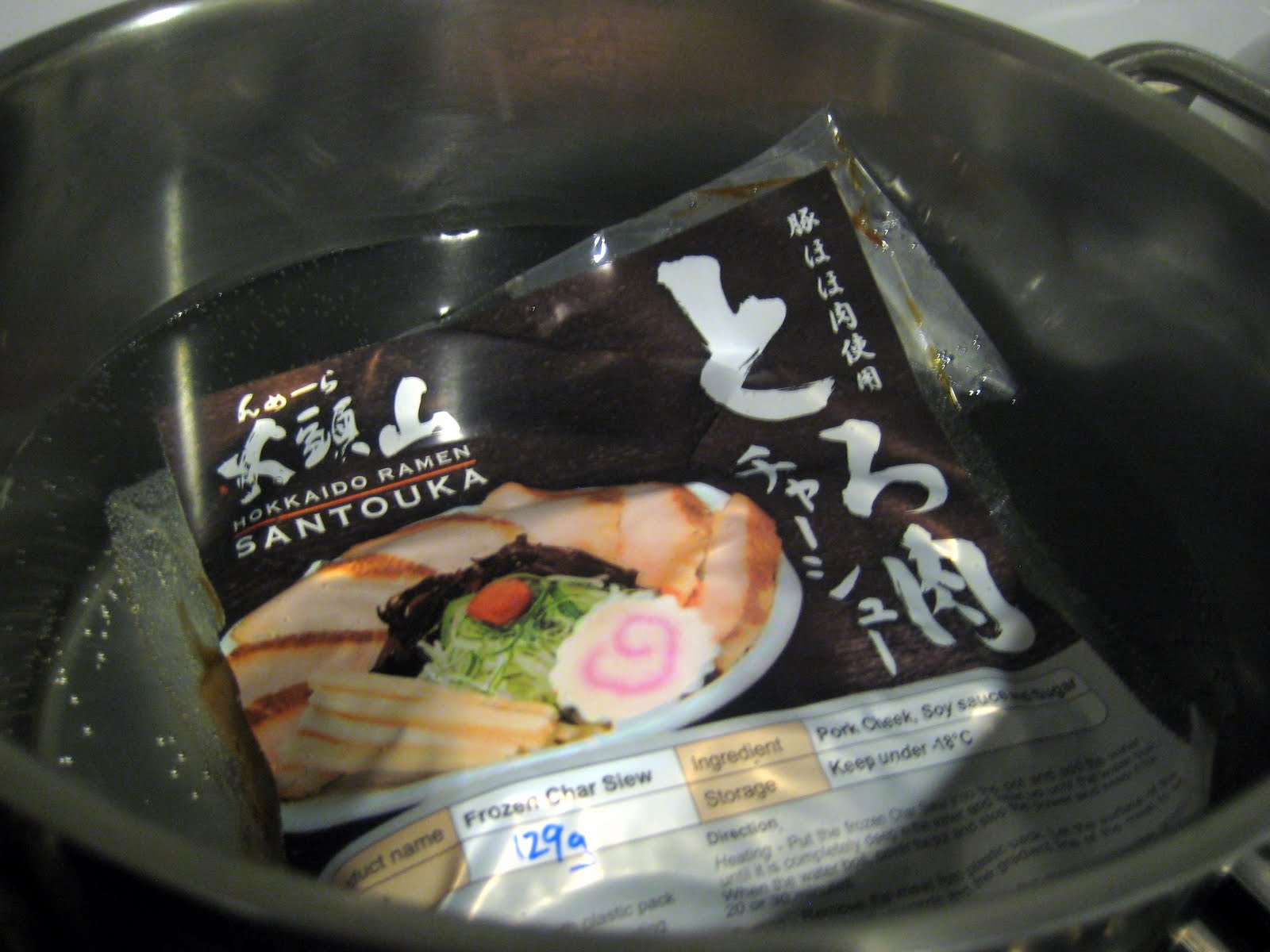
129g of toroniku...

The instruction says that we have to put the frozen pack of char siew into a pot of water. When the water boils, switch off the fire and let the pack soak in the hot water for 20-30 minutes, and its done!

Slicing it the Santouka way...

It looks pretty similar to those served in the restaurant, except that the colour looks darker.

Looks like the real thing!

It taste pretty much like what is served in the restaurant too - tender and flavoursome. The only thing is that layer of fat of the piece that I bought seems to be thicker, making the char siew a little fatty. All in all, it was good!

The expiry date of the char siew seems to be a whopping 1 year from the date of manufacture. Ramen fans of Santouka may want to consider stocking it up at home to satisfy the sudden cravings.

I've kept a few pieces for the ramen that I bought from the fair too :)
Will blog about it when I cook it.
Related Posts with Thumbnails